

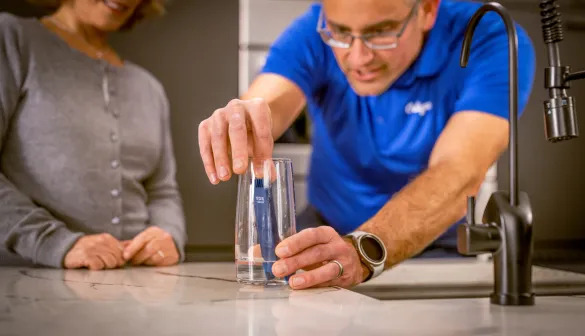
The Culligan Tea Test is a simple yet powerful demonstration used by Culligan to show how water quality directly affects what you drink. In this test, tea is brewed side-by-side using regular tap water and Culligan-treated water, allowing you to see and taste the difference. Tea made with untreated water often appears darker or cloudy, may develop a film on top, and can have a bitter or off taste due to minerals like calcium and magnesium, chlorine, and other dissolved solids. In contrast, tea made with treated water is typically clearer, brighter in color, and smoother in flavor because many of those impurities have been reduced or removed. The demonstration makes water quality easy to understand by showing, in a real-world way, how better water leads to better taste—proving that what’s in your water impacts everything you consume.
The difference in color is coming from the metals and inorganic particles in your tap water, including calcium, magnesium, potassium, sodium, bicarbonates, chlorides and sulfates. These particles are known as total dissolved solids (TDS). What is TDS and TSS in water? These particles, or ‘solids’, can be divided into two types by passing the water through a filter. The particles that are large enough to be held back by the filter are called total suspended solids (TSS), while the particles that pass through the filter are called total dissolved solids (TDS).
Water Filters don’t remove Important Minerals from your Water
Studies have found that minerals in your drinking water make essentially no contribution to your health and may even be present in forms your body can’t absorb. Minerals in an inorganic state flow through our systems versus minerals in an organic state that are readily absorbed by our bodies. You are much better off maintaining a balanced diet that provides you with an adequate supply of important vitamins and minerals.
The Culligan Tea Test works because tea is extremely sensitive to what’s in your water. When you brew tea with untreated tap water, minerals like calcium and magnesium (hardness), along with chlorine and other dissolved solids, interfere with how the tea extracts. This often results in a darker, cloudy appearance, a film on top, and a more bitter or flat taste. When the same tea is brewed with water treated by Culligan, those interfering elements are reduced or removed. The result is a noticeably clearer, brighter color and a smoother, cleaner taste, proving in a simple, visual way that better water leads to better beverages.
To achieve those results at home or in a business setting, Culligan typically combines two types of systems. A water softener removes hardness minerals that cause cloudiness and dull flavor, while a reverse osmosis (RO) system or advanced filtration further reduces chlorine, dissolved solids, and impurities that impact taste and odor. Together, these systems create water that allows tea to extract properly—giving you truer color, better aroma, and a more enjoyable flavor in every cup.
Why Water Testing is Important
Water quality can no longer be taken for granted. There are many variables that can come into play: the possibility of contaminated water, our aging water distribution system, unknown well-water quality and the type of plumbing in your home. Many don’t realize it’s common for municipalities to supply you with hard water too. If your home has water supplied by the city, it probably meets federal standards, but are those standards your standards?
Whether your home’s water is supplied by a municipality or a private well, it is important to understand what is and isn’t in your water. By having your water tested, you will learn about the quality of your water, if any contaminants are present and what water treatment options are available to improve your water.
Public water treatment facilities work very hard to ensure your city water is safe to drink. Unfortunately, some contaminants may be difficult to detect or treat realistically on a large scale. And after the water leaves the treatment plant, contaminants can also enter the water system through gaps in the infrastructure or from aging pipes.
Private water sources, or wells, have their own challenges and need extra attention and precautions. Since a private well’s water quality is at risk when the water comes in contact with naturally-occurring and man-made contaminants, it needs to be regularly tested to ensure it’s safe to drink.







Some filters only remove certain minerals. The filters are designed to remove unwanted impurities from water, but not all of the impurities in water. It is important to use a reliable filter, or find another source for water to be safe.